Excess subterranean moisture and coastal morning marine layers drive thousands of scavenging arthropods toward concrete foundations across coastal San Diego County. Earwigs (order Dermaptera) and pillbugs (terrestrial…
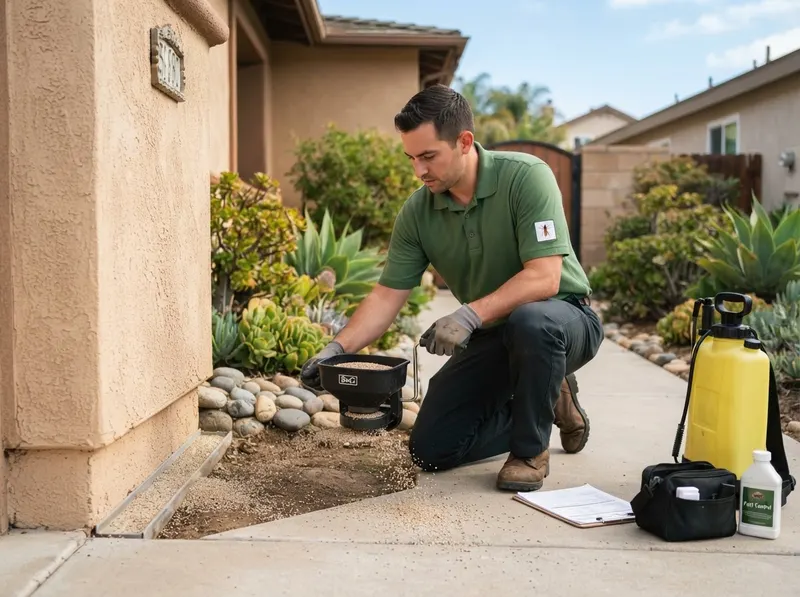
Excess subterranean moisture and coastal morning marine layers drive thousands of scavenging arthropods toward concrete foundations across coastal San Diego County. Earwigs (order Dermaptera) and pillbugs (terrestrial isopods) inhabit dark, damp mulch, flagstone patios, and dense groundcovers like ice plant. When hot midday sun dry soil beds in neighborhoods like Clairemont, Pacific Beach, and Ocean Beach, these invertebrates migrate upward, seeking cracks along masonry veneers and stucco weep screeds. Implementing physical and botanical deterrence stops these populations outside the home before they infiltrate baseboards, ground-floor bathrooms, and carpet tack strips.
Effective defense begins with structural exterior assessment. In canyon-edge properties found throughout Carmel Valley, Mira Mesa, and Mission Valley, heavy landscape irrigation saturates foundation footings, generating ideal breeding conditions. Certified applicators licensed under the California Structural Pest Control Board inspect crawl space access wells, utility penetrations, and perimeter expansion joints. The team evaluates pest populations by observing biology outlined by the UC Statewide IPM Program, applying targeted perimeter deterrence rather than indiscriminately drenching baseboards indoors.
1. Technicians assess exterior grading, perimeter mulch thickness, and weep screed clearances around the entire structure.
2. Landscape crews or homeowners pull organic soil cover back 12 inches from concrete stem walls to eliminate conductive moisture corridors.
3. Technicians treat crawl space foundation vents, sub-floor access doors, and structural slab voids with micro-encapsulated biological dusts complying with the California Department of Pesticide Regulation standards.
4. Micro-barrier bands measuring 24 to 36 inches wide are placed along low exterior walls using reduced-risk active compounds aligned with EPA pesticide safety guidelines to protect coastal stormwater runoff entering waterways regulated by the San Diego Regional Water Quality Control Board.
Decision guidance depends on moisture conditions. If a property features dry decorative gravel and grade-level concrete slabs, mechanical gap sealing and micro-barrier granules deliver long-term suppression. However, if properties in North Park or Hillcrest feature heavy redwood bark mulch resting directly against 1920s raised foundations, physical habitat modification must precede application. The operational trade-off centers on landscape design versus treatment longevity: thick organic mulch buffers plant roots against heat but continuously shelters decomposing isopod colonies, requiring active 60-day maintenance cycles. For properties near sensitive habitats like Torrey Pines State Natural Reserve, Balboa Park, or coastal preserves managed by the U.S. Fish and Wildlife Service, micro-targeted applications avoid synthetic runoff while keeping foundation perimeters sealed. All field protocols adhere strictly to national applicator guidelines established by the National Pest Management Association and structural health benchmarks from the Centers for Disease Control Environmental Health Services.
Every job gets a firm, written price after a free on-site visit.
For standards, safe disposal, and service guidance on pest control services in San Diego, CA, useful references include U.S. EPA, ENERGY STAR, U.S. Dept. of Energy, Consumer.gov, U.S. Census Bureau, and Google Maps. General consumer and small-business resources are available from USA.gov, Better Business Bureau, FTC Consumer Advice, U.S. Small Business Administration, and Ready.gov.
Tell us about your earwig and pillbug foundation deterrence job in San Diego and we'll send a clear, written quote, usually the same day.
 Greenway Insect Control